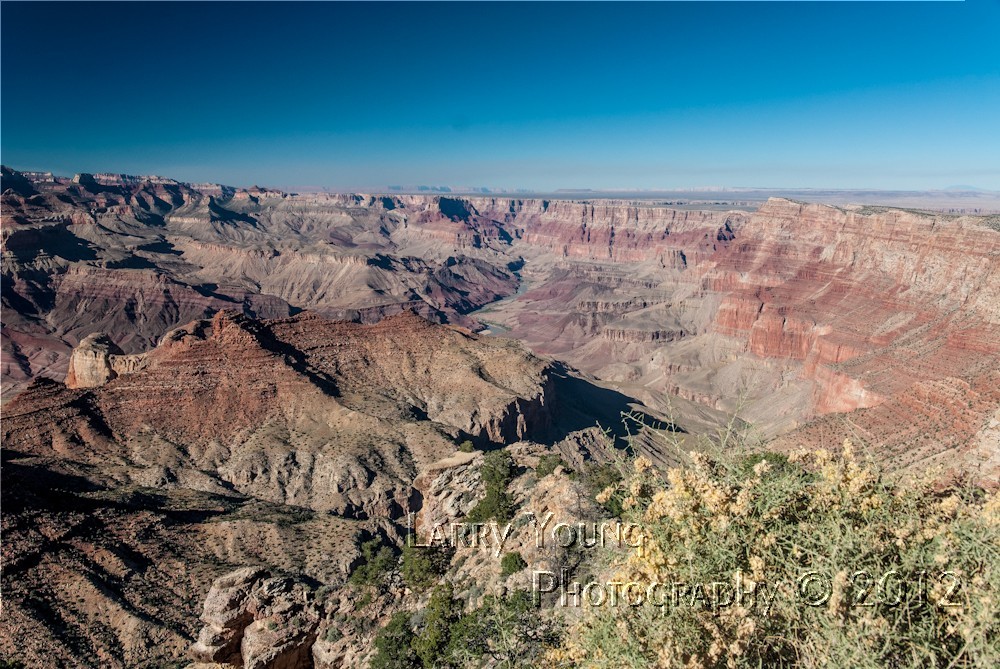
Desert View Lookout Grand Canyon

Desert View Lookout Grand Canyon

Wednesday, October 17, 2012

Grand Canyon


The Grand Canyon

More than 5 million years ago the Colorado River began carving out the canyon we now know as the Grand Canyon.  There are three distinct layers of rock that make up the canyon walls.  The softest of the layers are located at the bottom, thus, the rapid erosion.  Exposed rocks in the canyon are between 1.7 million to 4.7 million years old making it the oldest exposed rock on earth.  Originally the river brought sediment downstream and was red in color.  That is why it was named the Colorado.  In 1956 the Glen Canyon Dam was built near the headwaters of the Colorado River.  When completed, Lake Powell was formed. The lake collects the sediment and now the Colorado no longer runs red.  Eventually (not in our lifetime) Lake Powell will fill with sediment and the river will again run red.  It’s only a matter of time.

The Grand Canyon extends East to West for 277 miles.  The south rim is located at about 7,000 feet and the North rim is about 8,000 feet.  The only way to get from the South rim to the North rim on land,  is to walk, or ride a mule down into the canyon and up the other side, or drive.  Although it is about 11 miles across, the drive is over 200 miles.  There are no roads that cross the canyon.  You have to go all the way to the eastern edge of the canyon and cross the Navajo Bridge to cross the Colorado River.  

With more than 4.5 million visitors a year, the Grand Canyon is one of the most popular of our National Park System.  The park can be very crowded in the Spring, Summer, and Fall.  The best times to visit are in the Spring after school starts and Fall.  Winter can be a very beautiful time in the canyon.  Crowds are light and the air is crisp.  Facilities at the South rim are open year round.  Although, it not uncommon to see snowfall.,  The snow on the formations make stunning pictures.  Because the North Rims is at 8,000 feet elevation, snow forces closure of roads leading to the North rim.


                          The Watchtower at Desert View


Desert View


The Watchtower


Watchtower in Background


Friday, September 7, 2012

Taos Pueblo


Taos Pueblo

I have loaded some pictures of the famous Taos Pueblo in Northern New Mexico. 
The Pueblo is at an elevation of about 7000 feet and has been occupied for more than 1000 years.  Today about 150 people occupy the pueblo full time.  Many other families have other homes in the Taos area, but return to the Pueblo for gatherings and special occasions.  Traditions dictate that no running water or electricity are allowed within the Pueblo walls.   The two main structures, Hlauuma (North House) and Hlaukwima (South House) are considered to be the oldest continiously inhabited communities in the USA.

The Pueblo is open to the public for an admission fee.  You can watch them making bread, clothing, jewelry, artwork, and other native items during your visit.  Of course, all available for purchase.

Thursday, August 23, 2012


Did You Know…?
Native American reservations comprise over 27% of the entire state we know as Arizona.

Native Americans have lived in the Arizona for at least 25,000 years, maybe as long as 30,000 years.

Three of the earliest tribes in the Arizona region were the Hohokam, Anasazi, and Cochise.

The Hohokam were pretty much gone by 1400 A.D.  However, it is believed that the some of the current Pima tribe were descendents of the Hohokam.  Hohokam is a Pima word meaning “Those Who are Gone”.

The Anasazi is a Navajo word meaning “The Ancient Ones”.  The Anasazi civilization reached its peak between 1000 A.D. and 1300 A.D. 

Friday, August 17, 2012


Welcome!
After much delay, planning for the Americana Tour is back underway.  We have not been very successful in obtaining corporate funding, and private donations have not met expectations.  So, we will begin as a self financed project.  The original focus will remain the same, but the scope of the project will have to be altered significantly.

With that said…
What better way to begin our tour, than to start with our first nations tribes of Arizona.  The Navajo, Havasupai, Hopi, Cocopah, Kaibab, Apache tribes are just some of the twenty-one Indian tribes located in Arizona.  Who can forget (if you’re over 40), Cochise, chief of the Chokonen band of the Chirichua Apache nation.  These tribes were the first nations of what eventually became the United States of America and had a great influence on our history.
Many of our National Parks and National Monuments are located on tribal land in Arizona.  The Grand Canyon National Park, Monument Valley Navajo Tribal Park, and Canyon de Chelly National Monument  are just a few that we will be visiting in October and November this year.

If you wish to be part of the experience, you can follow along by clicking “Like” on our Facebook  page or follow our blog.  Links for both are located on my web site at http://www.LYPhotography.com

Monday, June 14, 2010

Visit To Safari West


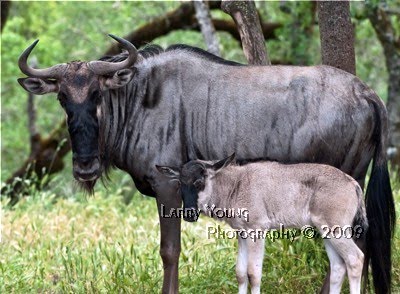
Last week I had the fortunate opportunity to re-visit Safari West in Sonoma County. This was my second visit in less than a year and my guide Adrian Boyer provided a tour with views of animals I had not seen at the preserve before. Namely, all the new babies. As spring has arrived, it has brought a whole host of new animals. We saw many young Zebras, Cape buffalo, Waterbuck, Eland, Giraffe, Blue wildebeest, and many other small animals.

If you have never been to Safari West, you have missed out on a real treat. It’s almost like a true African Safari, but it doesn’t cost $6,000.00 and its right here in our backyard. Safari West is located just seven miles east of Highway 101 at 3115 Porter Creek Rd., Santa Rosa California. Coming south from the San Francisco area, exit Hwy 101 at Calistoga/Mark West Springs Rd. Head east and Safari West is seven miles on the left.

They have over 400 animals on 400 acres in the wine country. Safari West is one of only six private facilities in all of North America to gain membership in the prestigious American Zoo and Aquarium Association. Safari West is not a zoo, and is not a drive-thru park. It’s a true wildlife preserve that is dedicated to conservation programs and saving endangered species. The greatest part about it though is you can interact with the animals close up. I mean close up. Have you ever had your head licked by a giraffe? You won’t find that in a zoo. Safari West has many highly trained employees that care for the animals. Included are the knowledgeable tour guides who become your direct contact with the animals. The guides load everyone up in an open air jeep type vehicle that has been specifically modified for safaris. Some people will sit on padded bench seats behind the driver and some can sit on the “top shelf” above the driver. Either place is a great view. The tour typically lasts 2 ½ to 3 hours. While on the tour, you must remain safely inside the vehicle, but the tour also includes a walking portion where you will get to see many of the smaller animals, including the Cheetahs. Yes, I said Cheetahs. In addition to the tours, if you wish, you can also camp in their tent cabins. What an experience! You get to hear all the sounds of Africa at night and not have to travel 10,000 miles. Tent camping at Safari West is a great way to get the full experience of an African safari. As with all tours, camping, and dining at Safari West, reservations are required (no, they don’t serve Cape buffalo in the restaurant). To make your reservation you can visit their web site at http://www.safariwest.com/ or call them at 800-616-2695.

As I said before, all the guides are highly trained and provide a great experience. However, I highly recommend guide Adrian Bowyer. Adrian has worked with Safari West for over 7 years and provides a very entertaining and knowledgeable tour. He is an accomplished photographer who is currently putting together a book called “A Field Guide to Safari West Mammals”. This book should be published soon and will be a very valuable resource. When you get home and see your pictures, you will want to send them to all your friends, but I guarantee you will not remember what the names of most of the animals are, because you’ve probably never seen them before your visit to Safari West. I know I have returned home and viewed my pictures only to have to send Adrian an email and picture and ask “what’s this”? Who better to give you a tour than the one who has written a book about it? By the way, just for fun, ask Adrian if he has sang in any operas lately.


Happy trails, and be sure to visit Safari West soon. It’s an experience you will want to do more than once. Remember, make reservations.